What colors go with your clothes?
Pick a color and see the colors that work with it. Use the chip closest to a piece you own, or sample one from a photo.
Not in the deck?
Your photo is read on this device and never uploaded.
Olive
- Hex
- #67683D
- RGB
- 103, 104, 61
- Deck
- No. 25 of 30
Olive is an earthy green-brown that behaves like a neutral. It pairs best with warm and muted colors.
Shoes that tend to work
Metals
Gold or brass.
Neutral partners
Safe bases that let your color lead.
Tonal
Lighter or deeper shades from the same family.
Contrast
Colors from the other side of the wheel, toned for clothes.
Accent
Best in a small dose: a bag, scarf, shoe or knit.
One pair of olive chinos, three new tops
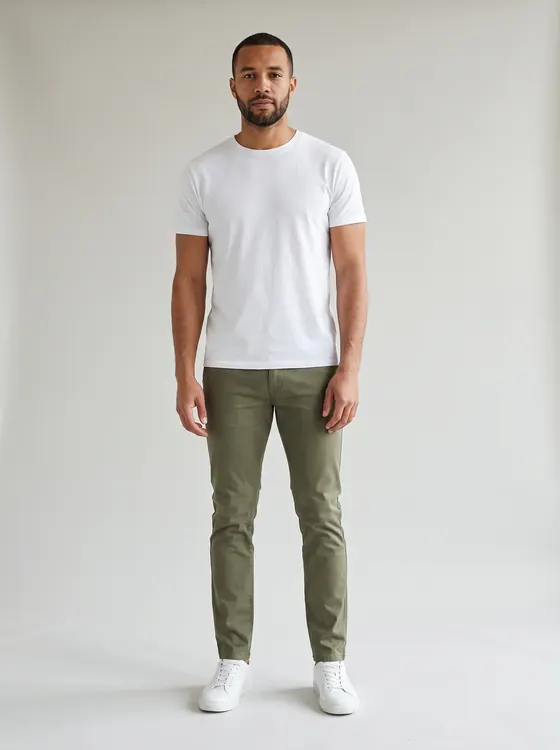
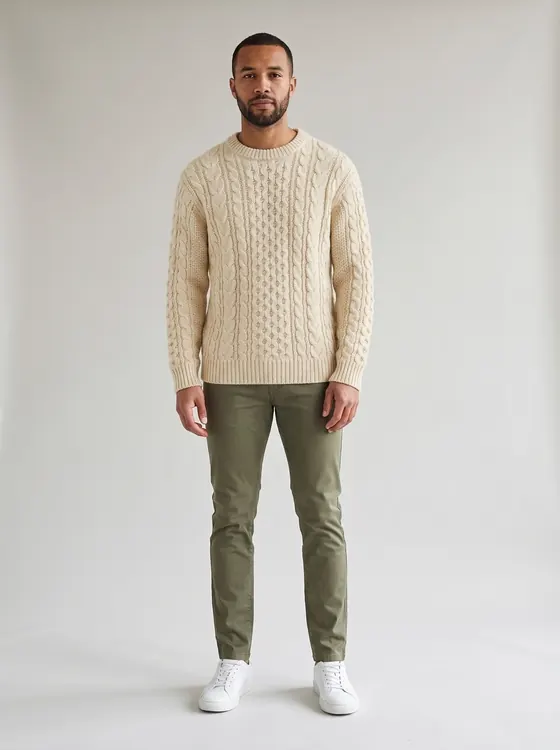
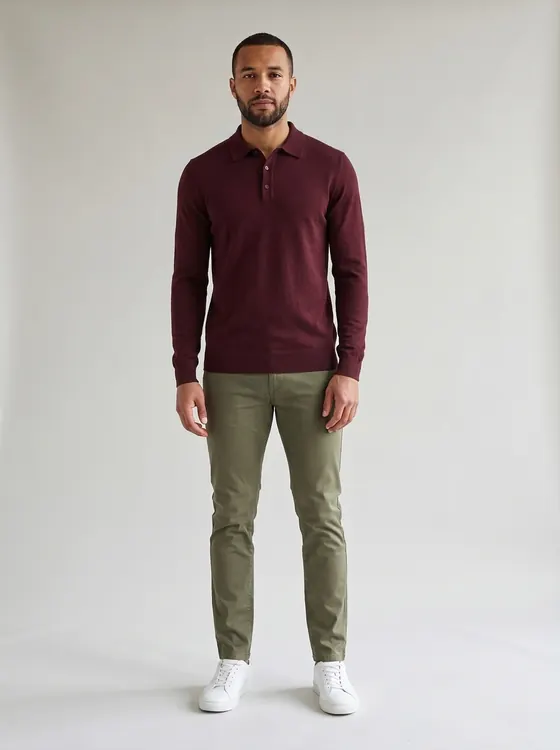
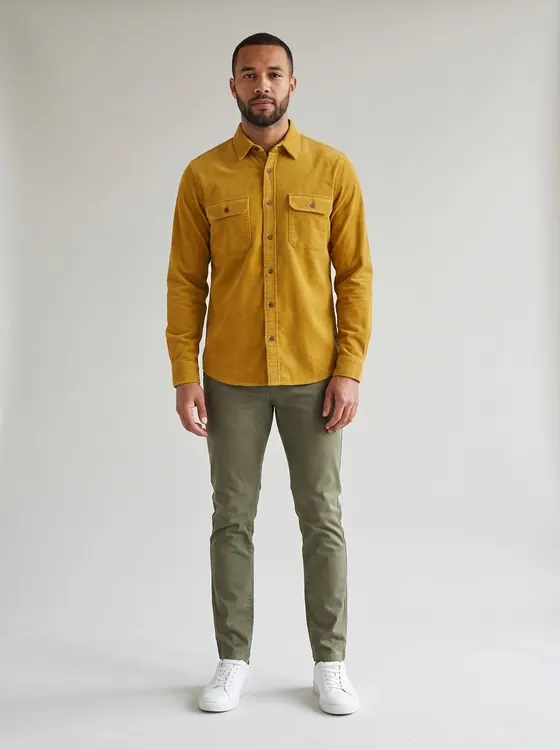
The original photo has a plain white tee. Each new top comes from a different group on the olive chip: neutral, contrast and accent. Switch between the four frames to see how the same trousers change character.
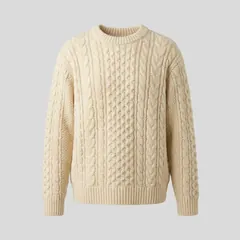 Garment used
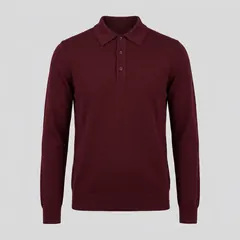 Garment used
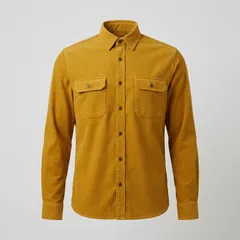 Garment used
The starting photo: olive chinos with a plain white tee. White is olive's easiest neutral partner, crisp and clean, but it leaves the chinos doing all the talking.
Neutral partner. Cream is a softer, warmer white, and its warmth suits olive's yellow-green base. The chunky cable knit gives a low-contrast pairing enough texture not to look flat.
Contrast. Red and green sit opposite each other on the color wheel. In their deep, muted forms, burgundy and olive look rich rather than festive, and this is the darkest, most evening-ready of the three.
Accent. Golden yellow warms olive and leans fully into earthy autumn colors. It is the loudest option, so everything else stays plain: white sneakers and no other color.
Try a pairing on your own photo
Upload a photo of yourself and a photo or shop link of a garment; FitInView shows you wearing it. Handy for checking a color pairing before you buy.
Your first try-on is included with a free account. No card needed. Your photos are private to your account, and you can delete them.
How the deck sorts partners
Color matching clothes gets easier when you stop asking whether two colors go together and ask what job the second color does. Every chip in the deck lists its partners in four groups.
Neutral partners
Navy with white, gray and camel
The safe bases: white, cream, beige, gray, charcoal, black, navy, camel and brown, plus denim. They let your color lead. Which neutral works best depends on depth and warmth: warm colors such as olive and rust prefer cream, camel and brown; cool colors such as cobalt and lavender prefer white and gray.
Tonal
Light blue, denim, navy and cobalt
Lighter or deeper shades from the same color family. A tonal outfit looks deliberate when the shades are clearly different in depth. Two shades that almost match tend to look like a mistake instead.
Contrast
Navy with mustard and rust
Colors from the other side of the color wheel, which is where complementary colors in fashion come in. Full-strength opposites are loud, so the deck suggests muted or deep versions: navy with mustard rather than blue with yellow, burgundy with olive rather than red with green.
Accent
A gray outfit with a cobalt accent
A color best worn in a small dose: a bag, a scarf, shoes, a beanie, a knit under a coat. Accents give a neutral outfit a focal point. One is usually enough.
Outfit color combinations: rules of thumb that hold up
None of these are laws. They are the patterns behind most outfits that look easy, and they explain why the deck suggests what it does.
Start with one color and add neutrals
Most good outfits have one color that leads and neutrals that support it. If you are unsure, build around the piece you like most and fill the rest from its neutral partners.
Match depth, not just hue
Colors of similar depth sit together calmly (navy and burgundy, cream and blush). Colors far apart in depth create contrast (navy and white, chocolate and light blue). Both work; trouble starts when two colors are almost, but not quite, the same depth and hue.
Keep warm with warm, cool with cool, or mix on purpose
Olive, rust, mustard, camel and cream share a warm base, so they look cohesive. Gray, cobalt, lavender and white share a cool one. Warm and cool together, such as camel with navy, is a classic contrast that works because the depths differ.
Mute one side of a contrast
Complementary colors at full strength fight for attention. Deep or dusty versions (plum and mustard, teal and rust) give the same energy in a wearable way.
Repeat a color once
A color that appears twice looks intentional: a camel coat with tan shoes, a burgundy scarf with burgundy loafers. It is the easiest way to make three colors feel like one outfit.
Let shoes and bags anchor or echo
Shoes either anchor an outfit with a darker neutral (brown, black, navy) or echo one of its colors. Bags are the easiest place for an accent, because they are small and easy to change.
Check in daylight
Dark navy, black, charcoal and chocolate can look identical indoors. Before pairing two dark colors, look at them by a window.
Color guides
Longer guides for the colors people ask about most, with outfit formulas, shoes, bags, metals and the pairings to skip. Each one has its own try-on example.
- What colors go with navyWhite, Gray, Camel and more
- What colors go with olive greenWhite, Cream, Navy and more
- What colors go with burgundyGray, Navy, Camel and more
- What colors go with beigeNavy, White, Black and more
- What colors go with grayWhite, Black, Navy and more
- Color wheel for outfitsComplementary, analogous and triadic, made wearable
Questions about color matching clothes
What colors go together in an outfit?
A reliable starting point is one main color, one or two neutrals (white, cream, gray, beige, navy, black or brown) and, if you like, one small accent. Colors that share depth or warmth tend to sit well together; colors from opposite sides of the wheel give contrast and work best when one of them is muted or small.
What are complementary colors in fashion?
Complementary colors sit opposite each other on the color wheel, such as blue and orange, red and green, or purple and yellow. In clothes they work best in muted or deep versions (navy with rust, burgundy with olive, plum with mustard) rather than at full brightness.
How many colors should an outfit have?
There is no fixed rule, but many outfits look calm with two or three colors, counting neutrals. A common rule of thumb borrowed from interior design is roughly 60% main color, 30% secondary and 10% accent.
Do my shoes have to match my bag or belt?
Not exactly. A common guideline is to keep belt and shoes in the same color family when you wear leather, especially in formal outfits. Bags have more freedom and are a good place for an accent color.
How does the photo color picker work?
Your photo is drawn onto a canvas inside your browser. When you tap a spot, the page averages the pixels around it and finds the closest chip in the deck. Nothing is uploaded. Lighting and camera settings change how a color looks in a photo, so the result is an approximation.